
Case study
LostPass — Local-First Password Manager + Licensing
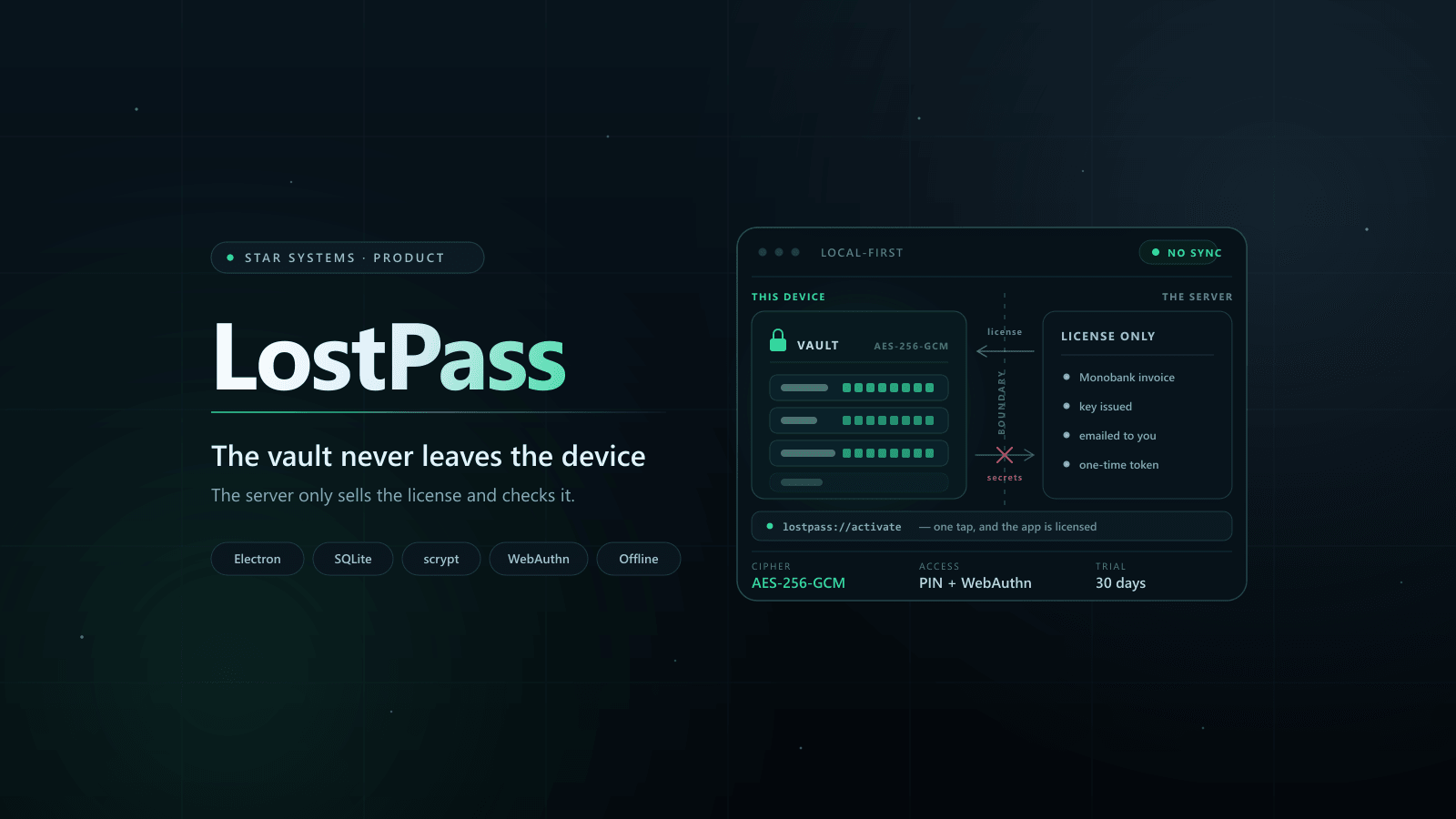
A desktop vault on Electron with encrypted local SQLite (AES‑256‑GCM) and PIN/WebAuthn, plus a licensing server for subscriptions via Monobank, email key delivery, and deep-link activation.
Overview
Project overview
LostPass is a local-first password manager: the encrypted vault lives only on the user’s device. The server exists strictly for the commercial flow — purchase/renewal, license issuance and verification, email delivery, and one-tap activation inside the app via deep-link.
ROLE
Full Stack Engineer
FOCUS
- Local-first architecture (offline by default)
- Encrypted vault + PIN auth
- Anti-bruteforce + optional biometrics
- Commerce-only backend (payments + licenses)
- Deep-link activation flow
Story
Problem → Solution → Outcome
PROBLEM
We needed to ship a trust-first password manager without cloud sync: a secure local vault, strong access control, and a commercial flow (trial, checkout, license delivery) that feels seamless.
SOLUTION
Built the desktop app with an encrypted SQLite vault (AES‑GCM) and PIN/WebAuthn access, then implemented a licensing server that sells subscriptions via Monobank, sends keys by email, and supports one-time, token-based activation through deep-link.
OUTCOME
A privacy-first product with a complete monetization loop — while keeping the vault strictly local and the server limited to licensing only.
Highlights
What we built
Key systems shipped end-to-end — designed for reliability, conversion, and scale.
Encrypted local vault
Passwords never go to the server — everything stays inside a local SQLite database on the user’s device.
- Vault stored in user profile (app.getPath('userData')/data).
- Each record encrypted with AES‑256‑GCM (IV + tag + ciphertext).
- Offline-first: works without the network (except licensing).
Access control that holds up
PIN-derived encryption keys (scrypt) plus optional platform biometrics via WebAuthn.
- PIN is never stored (only scrypt hash + salts/params in auth.json).
- Anti-bruteforce throttling with state protected via safeStorage.
- WebAuthn validation: signature checks, rpIdHash and signCount handling.
Commerce-only licensing server
SSR product site + licensing backend: checkout, renewals, key issuance, and email delivery — without ever seeing the vault data.
- Monobank Merchant checkout with webhook processing and status polling fallback.
- Token-based key reveal on success page (server stores only hash).
- One-time activation via deep-link with appToken TTL.
Challenges
Technical challenges
The hard parts — and the solutions that made the system stable.
Results
Impact
Measured outcomes and operational wins.
Local-first by design: the server never receives passwords or vault data — only licenses.
End-to-end monetization: trial → checkout → email key delivery → in-app activation/renewal.
Secure activation: one-time tokens with TTL and deep-link redemption.
Multi-language SSR site with SEO basics (canonical/hreflang, OG/Twitter, sitemap).
Stack
Tech stack used
Tools and patterns used on this build.
Desktop app
- Electron
- React
- TypeScript
- TailwindCSS
- sql.js (SQLite/WASM)
Security
- AES‑256‑GCM
- scrypt (PIN → key derivation)
- safeStorage
- WebAuthn (platform authenticator)
Web + licensing server
- Node.js
- Express
- EJS (SSR)
- i18n (ru/en/uk)
- SEO (hreflang, JSON‑LD, sitemap)
Payments + delivery
- Monobank Merchant
- Webhook + polling fallback
- Nodemailer (SMTP)
- Deep-link lostpass://activate
Storage (no DB)
- licenses.json + invoices.json
- Atomic writes (tmp + rename)
- Serialized updates queue
Metrics
Impact metrics
Trial
30days
Platforms
2Windows + Linux
Auth modes
2PIN + WebAuthn
Locales
3languages
Next
Next case study
Keep browsing the system.
Sadova Photographer — Next.js Marketing Platform
A commercial portfolio site built for lead generation: fast galleries, service landing pages, locations map, gift certificates, SEO structure, GA4 consent-mode analytics, and automated deploy.